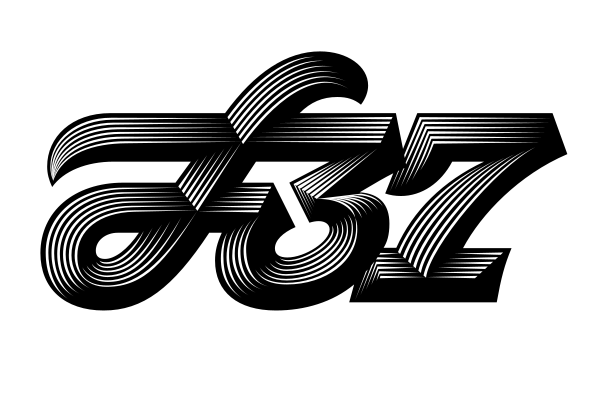
Modularity made fun!
Built from a minimal set of forms, Unitas combines disciplined grid fitting with an expressive, architectural character.
Michael C. Place
• F37 Unitas
• Styles 35
• 2025
The Designer


Michael C. Place: Son, Brother, Husband, Friend. Graphic designer. Artist. Northerner. Yorkshireman. Bite It! The Designers Republic. Studio.Build.


F37 Unitas
Interview
Tell us about the inspiration behind your collaboration with F37®×. If it was an unused concept, what was the potential use case for it.
Unitas started life in its very first simple form as a custom type we produced for the graphic identity of an exhibition at RIBA called 'Long Life, Low Energy: Designing for a Circular Economy'. I'm fascinated by modularity, and how using very few elements but arranging those elements in different ways can produce really interesting outcomes. I think it forces the designer to think there way out of a problem, and in the case of typography its a really interesting challenge. The initial concept for the RIBA show was how can we use as few elements as possible, and re-use this elements to create a typeface. We then expanded that simple concept by producing different weights, from Bold (Demolition/Big Impact) to Light (Re-use/Minimal Impact). In terms of a use case, it's an unashamedly DISPLAY(O) typeface. So anything that needs a bit of heft! Something that feels (oxymoron alert!) Precise but Free. Characterful but Solid, like a good Yorkshire drystone wall!
When starting the process of creating your font, what typographic conventions did you look to break or experiment with? Or were there conventions of functionality you championed?
The experimentation was more of a challenge I set to myself! How can we stick within the confines of a square, and a square grid construction to build out different styles (In Unitas case Big/Fancy/Silly/Soft)? It was an interesting challenge and a lot of fun to do. Some of the forms definitely challenge certain typographic conventions but I think it as a whole it works incredibly well. Each style has its own overall character, and as a family it feels cohesive too. You can mix-and-match the styles within the same block of text and it still works as the construction sits within the same set of restrictions...the DNA is the same. I like systems that in a way design themselves, because the underlying system is strong. It can carry oddities and unconventional-isms naturally, I like to not try and force these systems...but give in to them. The diacritics on Unitas were a good example, they might look very awkward to a purist, but I love the fact they look awkward! It felt natural to do them this way, so we did it! A little bit of ugly is a beautiful thing.
Now that your typeface has launched, what would be your dream project to use your F37® typeface on?
Apple rebrand? NASA rebrand would be nice too. Imagine that on the side of a space vehicle!?
What have you learnt through developing and creating your own typeface(s) with our F37® type designers?
That its a lot of fun. That letting go is part of the fun too! I am control freak, but only up to a certain point. I love working with experts, they are expert's for a reason (the clue is in the name), trust the experts. They can make a great project even greater. If they have a suggestion listen to it, if you don't agree say so, but listen. They are often correct.
How would you describe your typeface in three words?
Big and Clever.
F37 Unitas Font Sampler