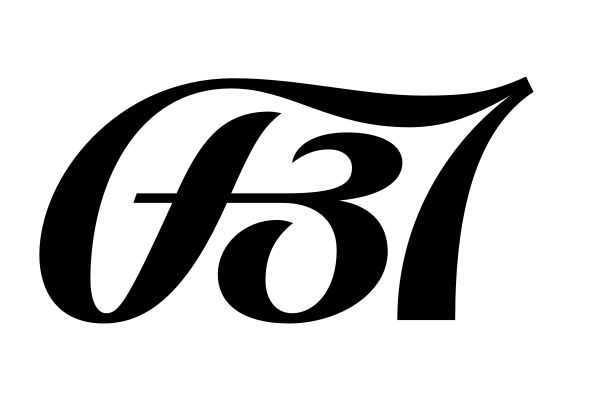
Emerging like a “Juggernaut,” a force whose advance is unstoppable, crushing or destroying all obstacles in its path.
Created from a modular concept, the characters grow and shrink, overwhelming the grid. Legibility is maximized, and the typographic fabric is enhanced by the large serifs that allow for quick and varied linking of characters. High contrasts between thin and thick strokes, a sense of robustness always present even in the most condensed versions, and the incorporation of various complementary elements to link them with the text and complement the overall design.
Esteban Ibarra
• F37 Not Today
• Styles 12
• 2026
The Designer


Many unsuccessful projects led me here.
A graphic designer and design professor from Argentina, with extensive experience in visual identity and logo design. Owner of a palette of simple, robust, and impactful shapes. In a constant search for the balance between extreme equilibrium and spontaneity. Passionate about hard forms, structures, and the geometry behind everything.


F37 Not Today
Interview
Tell us about the inspiration behind your collaboration with F37®×. If it was an unused concept, what was the potential use case for it.
From the moment I discovered F37, I was drawn to the innovative production and design of their typographic proposals. Adding to this was the motivation of seeing them develop typefaces collaboratively with some of my biggest influences, such as Ceci Erlich, Non-Format, Spin or Build. In my identity development projects for clients, I often explore diverse typographic universes to propose new approaches to logo design or the typographic landscape within the system. Based on this, I had several typographic phrase designs in development, which often remain in the realm of "not approved by the client." Among them was the beginning of something that later evolved into a very small personal project, a kind of manifesto: "not today." A simple phrase designed to adapt to different media and sizes, it had great potential for further development.
When starting the process of creating your font, what typographic conventions did you look to break or experiment with? Or were there conventions of functionality you championed?
The project seeks to push the boundaries of legibility and functionality. It aims to be a protagonist and experiment from the perspective of a typeface that refuses to be silent. Certain conventions are also challenged, starting with archetypes... what functions as uppercase can simultaneously be lowercase, due to the modular construction and the fact that all the characters are contained within the same box. It also intends to offer the user/designer a landscape defined by the typography treated as an image, with a solid structure and the multiplicity of ligatures that the inherent design of each character offers in combination with others.
Now that your typeface has launched, what would be your dream project to use your F37® typeface on?
The ideal dream would be for this typeface to start finding its place in more formal settings and expand the visual culture of viewers... hahaha although, seriously, I'd like to be able to incorporate it into work with a clothing brand, guerrilla posters, technology projects, and similar universes.
What have you learnt through developing and creating your own typeface(s) with our F37® type designers?
It was an incredibly enriching and emotional process. I never thought the day would come when I would design a real typeface, for the real world, and make it available to other creators... and the F37 team was fundamental to that endeavor. From the very beginning, they believed in me and saw the potential in a couple of letters that aimed to say something to the world. And then, during the process, they encouraged me, enthusiastically curated the work, and pushed me to expand my own boundaries even further.
How would you describe your typeface in three words?
Robust — Cryptic — Giant
F37 Not Today Font Sampler