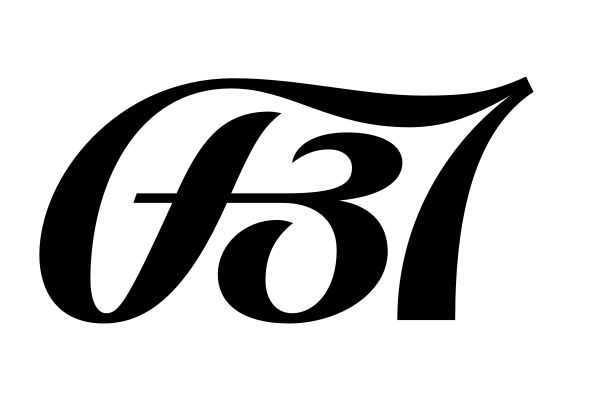
A typeface defined by extreme contrasts and dramatic transitions between thick and thin strokes.
F37 Inlink emerged in response to Place to Place, a funnel-shaped gold object by Adi Toch at the V&A, commissioned by the Gilbert Trust for the Arts. The work reflects on a 4,500-year-old gold ewer from the Gilbert Collection and its restitution to Turkey. The shapes of the letters were informed by the contours and character of the object, with deep curves and pronounced contrasts that echo its sculptural presence. Negative space is allowed to flow between them, creating a sense of rhythm and connecting pattern (hence the name).
Val Toch
• F37 Inlink
• Styles 5
• 2026
The Designer


A beardless brand designer and creative director, wriggling brands to be meaningful, connected, and desirable.
Val’s creative addiction began at Neville Brody’s Research Studios back in 2007, and since then he has worked with some of London’s top agencies including DixonBaxi, forpeople, JKR and currently at BrandOpus.


Inspiration


F37 Inlink®
Interview
Tell us about the inspiration behind your collaboration with F37®×. If it was an unused concept, what was the potential use case for it.
The typeface emerged in response to Place to Place, a funnel-shaped gold object by my talented wife Adi Toch at the V&A, commissioned by the Gilbert Trust for the Arts. She asked me to design a publication for the piece and for the cover I wanted to do something a little different. It began with abstract shapes that echoed the work, but on their own they didn’t feel right. From those forms the idea of a typeface quickly emerged. The title only required seven letters (PLACE TO PLACE), but it soon became clear there was potential to develop a full uppercase type system.
When starting the process of creating your font, what typographic conventions did you look to break or experiment with? Or were there conventions of functionality you championed?
I was aware of the typographic conventions I was about to break, but I had to set that knowledge aside and let the forms dictate the outcome – keeping an open mind rather than correcting what might normally be considered wrong. For example, the funnel-like verticals stand in sharp contrast to the horizontal thick-and-thin strokes of the curved letters. The result is clearly a display typeface, but one that allows new combinations to challenge what we think is possible and create something unexpected.
Now that your typeface has launched, what would be your dream project to use your F37® typeface on?
Faith in what’s possible! I was initially sceptical that a full lowercase set would work, and worried that lighter weights might lose the connection to the original concept. Ryan and the team proved me wrong — and I was delighted to see it.
What have you learnt through developing and creating your own typeface(s) with our F37® type designers?
It was an incredibly enriching and emotional process. I never thought the day would come when I would design a real typeface, for the real world, and make it available to other creators... and the F37 team was fundamental to that endeavor. From the very beginning, they believed in me and saw the potential in a couple of letters that aimed to say something to the world. And then, during the process, they encouraged me, enthusiastically curated the work, and pushed me to expand my own boundaries even further.
How would you describe your typeface in three words?
Contrasting concave indulgence
F37 Inlink® Font Sampler